

Topical Map — a practical, step-by-step SEO guide for 2025
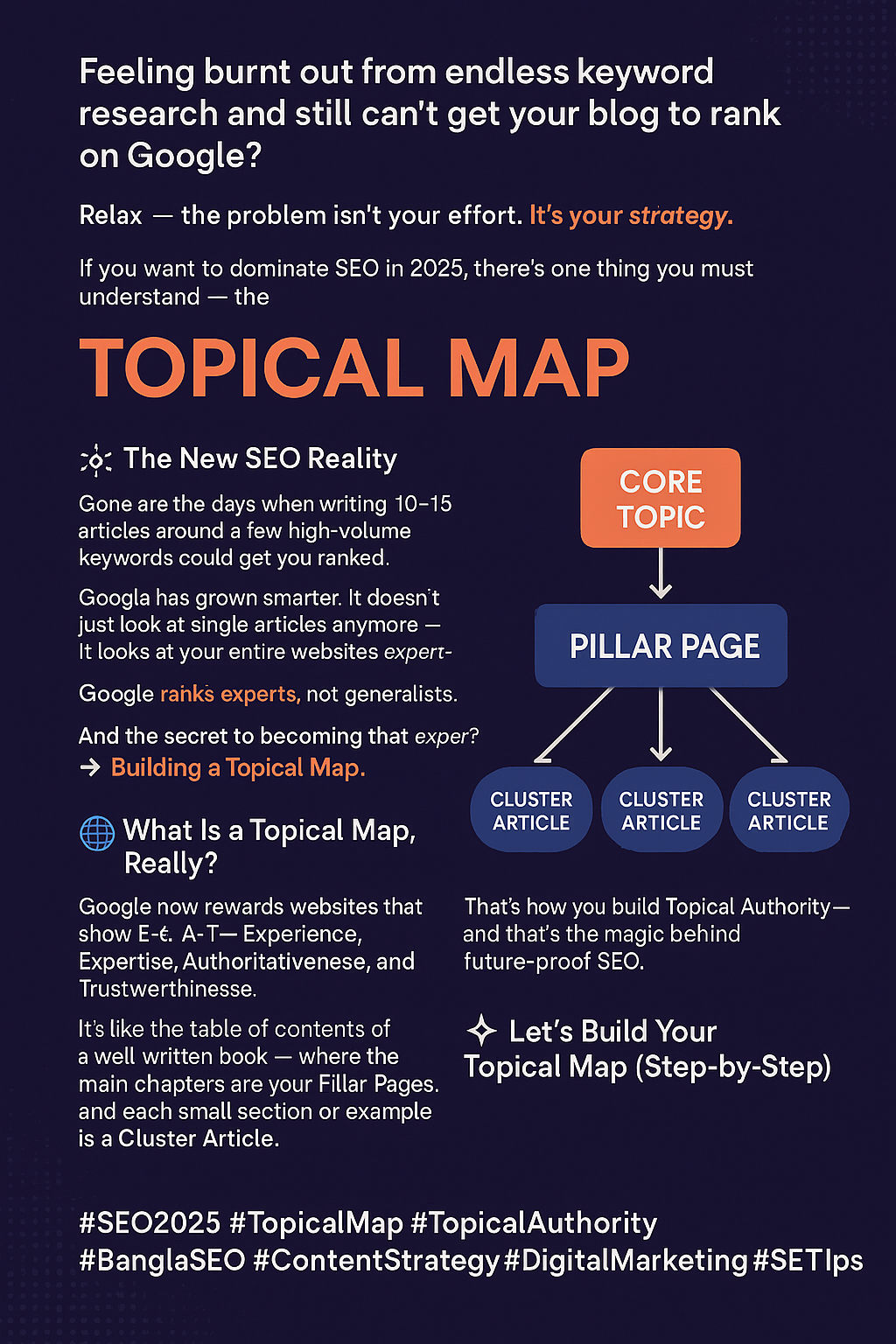
Feeling burnt out from endless keyword research and still can’t get your blog to rank on Google?
Relax — the problem isn’t your effort. It’s your strategy.
If you want to dominate SEO in 2025, there’s one thing you must understand — the Topical Map.
---
???? The New SEO Reality
Gone are the days when writing 10–15 articles around a few high-volume keywords could get you ranked.
Google has grown smarter. It doesn’t just look at single articles anymore — it looks at your entire website’s expertise.
Simply put:
> Google ranks experts, not generalists.
And the secret to becoming that expert?
???? Building a Topical Map.
---
???? What Is a Topical Map, Really?
Think of it like a blueprint for your website — a clear plan that shows:
What your main topic is
Which subtopics are connected to it
And how all your articles link together
It’s like the table of contents of a well-written book — where the main chapters are your Pillar Pages, and each small section or example is a Cluster Article.
---
???? Why Topical Map Is Crucial in 2025
Google now rewards websites that show E-E-A-T —
Experience, Expertise, Authoritativeness, and Trustworthiness.
When your site covers a topic A to Z, with smart interlinking between articles, Google instantly recognizes:
> “This site knows this subject.”
That’s how you build Topical Authority — and that’s the magic behind future-proof SEO.
---
???? Let’s Build Your Topical Map (Step-by-Step)
Step 1: Choose Your Core Topic
Pick one big but specific theme — something you can explore deeply.
Examples:
Gardening in Bangladesh
Freelancing for Students
Dhaka Street Food Culture
---
Step 2: Create Your Pillar Pages (Main Guides)
Break your core topic into 4–5 main categories.
These are your big, comprehensive articles — the foundation of your site.
For example, if your topic is Freelancing for Students, your Pillar Pages might be:
Getting Started with Freelancing
High-Demand Freelance Skills
How to Find Clients
Payment Methods in Bangladesh
---
Step 3: Add Cluster Content (Supporting Articles)
Now, for each Pillar, write 10–15 smaller, focused articles answering real questions people ask.
Use tools like AnswerThePublic, Google Keyword Planner, or even Reddit for ideas.
Example Clusters under “High-Demand Freelance Skills”:
How to learn graphic design for free
Best content writing courses in Bangladesh
Is web development a good career for students?
SEO for beginners (Bangla tutorial)
---
Step 4: Interlink Everything the Right Way
Here’s where many fail.
Think of your site as a hub and spoke system:
The hub = Pillar Page
The spokes = Cluster Content
Each Cluster links back to its Pillar, and the Pillar links to all its Clusters.
This internal linking tells Google, “Hey, all this content is related — and we’re experts on it!”
---
Step 5: Use AI to Make It Easier
Don’t spend hours brainstorming manually.
Use tools like ChatGPT or Claude with a smart prompt like this:
> Act as an expert SEO strategist and content architect.
I want to build topical authority on the subject of [Your Main Topic] for [Your Audience].
Create 4 Pillar Page ideas and 10–15 Cluster ideas for each, using the Hub and Spoke model.
Boom. In seconds, you’ll have a full content plan ready to go.
---
✨ The Bottom Line
Once your Topical Map is ready, you’ve got a clear, data-backed content plan that sets you up as an expert in your niche.
Now, it’s just about executing with quality content and consistent publishing.
That’s how you stop chasing algorithms — and start building authority.
Save this. Share it. And start your journey to becoming a Topical Authority in 2025.
---
#SEO2025 #TopicalMap #TopicalAuthority #BanglaSEO #ContentStrategy #DigitalMarketing #SEOTips
Share This Article
Comments ()